Pg. 485

June 18, 1853.]
THE ILLUSTRATED LONDON NEWS.
485
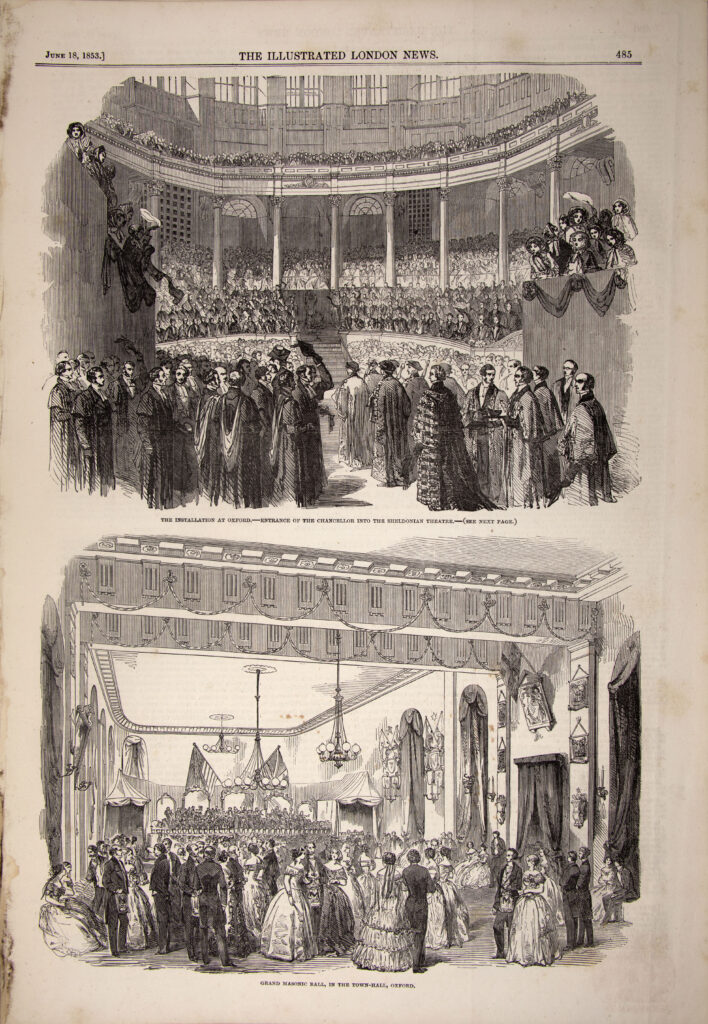
THE INSTALLATION AT OXFORD. ENTRANCE OF THE CHANCELLOR INTO THE SHELDONIAN THEATRE.—(SEE NEXT PAGE.)
GRAND MASONIC BALL, IN THE TOWN-HALL, OXFORD.
Page 121
June 18, 1853.]
THE ILLUSTRATED LONDON NEWS.
485
THE INSTALLATION AT OXFORD. ENTRANCE OF THE CHANCELLOR INTO THE SHELDONIAN THEATRE.—(SEE NEXT PAGE.)
GRAND MASONIC BALL, IN THE TOWN-HALL, OXFORD.
 Samantha Glance
An annual social celebration for the Freemasons, where members may bring their partners to celebrate the year in full regalia.
“154th Grand Masonic Ball.” Freemasonry: News About Masonry Around the World, 2013, http://freemasonry-cg.com/154th-grand-masonic-ball/.
Samantha Glance
The primary assembly location of Oxford University. The Archbishop of Canterbury, Gilbert Sheldon, paid for the building’s construction (1664-1669), so it was given his name upon completion. The architect behind the building’s design is named Sir Christopher Wren, who was at the time the University’s Professor of Astronomy. At the time of this publication, the building was 184 years old.
“History of the Building.” Sheldonian Theatre, University of Oxford, 2020, https://www.sheldonian.ox.ac.uk/building-history.
Samantha Glance
The Chancellor of Oxford University is the elected titular head of the University who presides over all major ceremonies.
“Governance.” University of Oxford, 2020, https://www.ox.ac.uk/about/organisation/governance.
Samantha Glance
The town-hall building for the city of Oxford. Built in 1752, the building was a major community hub for both merchants and political officials. From 1842 to 1879, it also housed the official post office.
“The Old Town Hall, Oxford.” Mayors & Lord Mayors, Oxford History, 2020, http://www.oxfordhistory.org.uk/mayors/town_hall/old.html.
Samantha Glance
The awarding of earned Doctorates of Civil Law by the elected Chancellor.
Oxford University Gazette [PDF]. Oxford University Press, 2002, https://gazette.web.ox.ac.uk/sites/default/files/gazette/documents/media/encaenia_2002_-_1_to_no_4628.pdf.
 Taylor Posik
Erroneous: wandering aimlessly
Tympanitic: referring to distension (expansion/swelling) of the abdomen by gas or air in intestines
Taylor Posik
Nervine tonic: herbs that nourish and support the central nervous system (Nervine Tonics: Benefits, How to Use & Potential Side Effects (healthline.com))
Anti-spasmodics: medication used to treat irritable bowel syndrome
Taylor Posik
Abscess: A circumscribed collection of pus or purulent debris, typically caused by a localized bacterial infection
Lumbar Region: on the spinal cord located between ribs and pelvis (Spine Anatomy Part 4 – Lumbar Region – Saratoga Spine)
Oxalate: a salt or ester
Calculi: kidney stones (Kidney Stone: Symptoms, Causes, Treatment, and More (healthline.com))
Taylor Posik
Hydatid Cyst: “Hydatid cysts result from infection by a tapeworm of either the Echinococcus granulosus or Echinococcus multilocularis and can result in cyst formation anywhere in the body. Hydatid disease also known as hydatidosis, is a zoonotic disease (a disease that is transmitted to humans from animals) caused by a parasitic infestation by a tapeworm of the genus Echinococcus 1. Human echinococcosis or hydatid disease is caused by the larval stages of cestodes (tapeworms) of the genus Echinococcus.” (Hydatid cyst causes, symptoms, diagnosis, treatment & prognosis (healthjade.net))
Malignant growth: cancer (Malignant growth | definition of Malignant growth by Medical dictionary (thefreedictionary.com))
Purulent: of the nature of or resembling pus
Taylor Posik
Timoressness (timorousness): quality of being fearful, timid
Taylor Posik
Integument: that which anything is covered, enclosed, or clothed
Taylor Posik
Subcutaneous: Of a process or a procedure, esp. the administration of a drug: taking place or performed under the skin or in the subcutis.
Taylor Posik
Caoutchouc: India-rubber, or Gum Elastic; the milky resinous juice of certain trees in South America, the East Indies, and elsewhere, which coagulates on exposure to the air, and becomes highly elastic, and is waterproof; it is now a most important substance in arts and manufactures.
Taylor Posik
Affusion: influx or accumulation of blood or serum
Hippocrates: (460 BCE – 370 BCE) Greek physician during age of Pericles (Hippocrates – Quotes, Oath & Medicine – Biography)
Source: https://1853archive.com/wp_annotation/the-illustrated-london-news-2/page-485/
The awarding of earned Doctorates of Civil Law by the elected Chancellor.
Oxford University Gazette [PDF]. Oxford University Press, 2002, https://gazette.web.ox.ac.uk/sites/default/files/gazette/documents/media/encaenia_2002_-_1_to_no_4628.pdf.
The town-hall building for the city of Oxford. Built in 1752, the building was a major community hub for both merchants and political officials. From 1842 to 1879, it also housed the official post office.
“The Old Town Hall, Oxford.” Mayors & Lord Mayors, Oxford History, 2020, http://www.oxfordhistory.org.uk/mayors/town_hall/old.html.
The Chancellor of Oxford University is the elected titular head of the University who presides over all major ceremonies.
“Governance.” University of Oxford, 2020, https://www.ox.ac.uk/about/organisation/governance.
The primary assembly location of Oxford University. The Archbishop of Canterbury, Gilbert Sheldon, paid for the building’s construction (1664-1669), so it was given his name upon completion. The architect behind the building’s design is named Sir Christopher Wren, who was at the time the University’s Professor of Astronomy. At the time of this publication, the building was 184 years old.
“History of the Building.” Sheldonian Theatre, University of Oxford, 2020, https://www.sheldonian.ox.ac.uk/building-history.
An annual social celebration for the Freemasons, where members may bring their partners to celebrate the year in full regalia.
“154th Grand Masonic Ball.” Freemasonry: News About Masonry Around the World, 2013, http://freemasonry-cg.com/154th-grand-masonic-ball/.