Pg. 496

496
THE ILLUSTRATED LONDON NEWS.
[June 18, 1853.
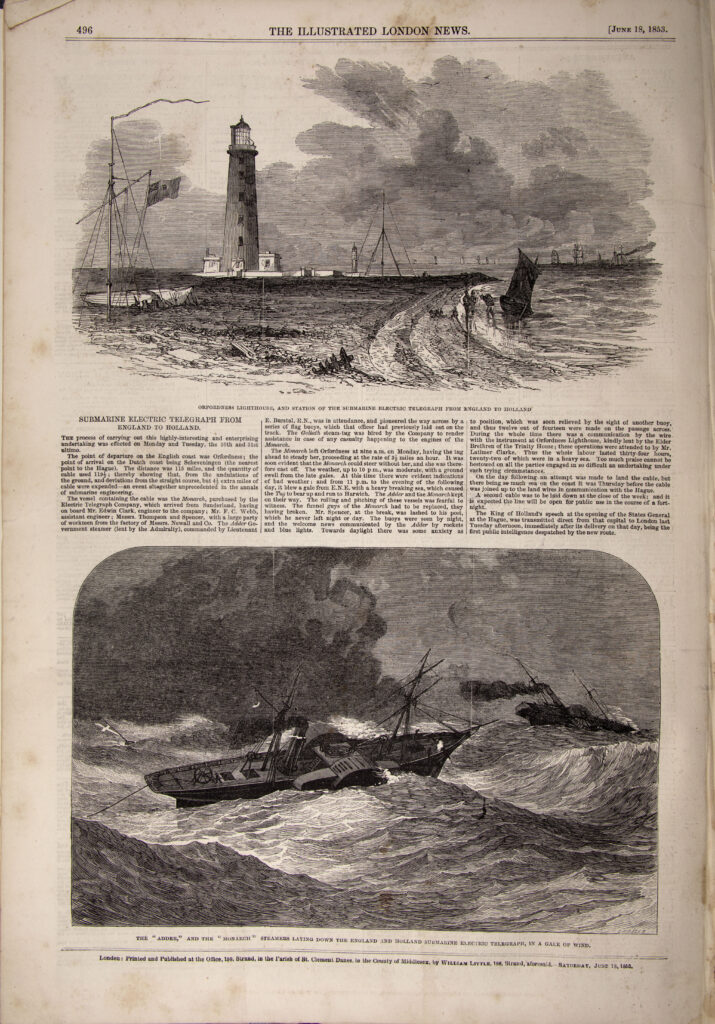
ORFORDNESS LIGHTHOUSE, AND STATION OF THE SUBMARINE ELECTRIC TELEGRAPH FROM ENGLAND TO HOLLAND
SUBMARINE ELECTRIC TELEGRAPH FROM
ENGLAND TO HOLLAND.
The process of carrying out this highly-interesting and enterprising undertaking was effected on Monday and Tuesday, the 30th and 31st ultimo.
The point of departure on the English coast was Orfordness; the point of arrival on the Dutch coast being Scheveningen (the nearest point to the Hague). The distance was 115 miles, and the quantity of cable used 119 1/2; thereby showing that, from the undulations of the ground, and deviations from the straight course, but 4 1/2 extra miles of cable were expended—an event altogether unprecedented in the annals of submarine engineering.
The vessel containing the cable was the Monarch, purchased by the Electric Telegraph Company, which arrived from Sunderland, having on board Mr. Edwin Clark, engineer to the company; Mr. F. C. Webb, assistant engineer; Messrs. Thompson and Spencer, with a large party of workmen from the factory of Messrs. Newall and Co. The Adder Government steamer (lent by the Admiralty), commanded by Lieutenant
E. Burstal, R.N., was in attendance, and pioneered the way across by a series of flag buoys, which that officer had previously laid out on the track. The Goliath steam-tug was hired by the Company to render assistance in case of any casualty happening to the engines of the Monarch.
The Monarch left Orfordness at nine a.m. on Monday, having the tug ahead to steady her, proceeding at the rate of 3 1/2 miles an hour. It was soon evident that the Monarch could steer without her, and she was therefore cast off. The weather, up to 10 p m., was moderate, with a ground swell from the late gales. At this time there were evident indications of bad weather; and from 11 p.m. to the evening of the following day, it blew a gale from E.N.E. with a heavy breaking sea, which caused the Tug to bear up and run to Harwich. The Adder and the Monarch kept on their way. The rolling and pitching of these vessels was fearful to witness. The funnel guys of the Monarch, had to be replaced, they having broken. Mr. Spencer, at the break, was lashed to his post, which he never left night or day. The buoys were seen by night, and the welcome news communicated by the Adder by rockets and blue lights. Towards daylight there was some anxiety as
to position, which was soon relieved by the sight of another buoy, and thus twelve out of fourteen were made on the passage across. During the whole time there was a communication by the wire with the instrument at Orfordness Lighthouse, kindly lent by the Elder Brethren of the Trinity House; these operations were attended to by Mr. Latimer Clarke. Thus the whole labour lasted thirty-four hours, twenty-two of which were in a heavy sea. Too much praise cannot be bestowed on all the parties engaged in so difficult an undertaking under such trying circumstances;
On the day following an attempt was made to land the cable, but there being so much sea on the coast it was Thursday before the cable was joined up to the land wires in communication with the Hague.
A second cable was to be laid down at the close of the week; and it is expected the line will be open for public use in the course of a fortnight..
The King of Holland’s speech at the opening of the States General at the Hague, was transmitted direct from that capital to London last Tuesday afternoon, immediately after its delivery on that day, being the first public intelligence despatched by the new route.
THE “ ADDER,” AND THE “ MONARCH ” STEAMERS LAYING DOWN THE ENGLAND AND HOLLAND SUBMARINE ELECTRIC TELEGRAPH, IN A GALE OF WIND.
London: Printed and Published at the Office, 198, Strand, in the Parish of St. Clement Danes, in the County of Middlesex, by William Little, 198. Strand, aforesaid.- Saturday, June 18,1853.
 Taylor Posik
Comments
0 Comments on the whole Page
Leave a comment on the whole Page
0 Comments on paragraph 1
Leave a comment on paragraph 1
0 Comments on paragraph 2
Leave a comment on paragraph 2
0 Comments on paragraph 3
Leave a comment on paragraph 3
0 Comments on paragraph 4
Leave a comment on paragraph 4
0 Comments on paragraph 5
Leave a comment on paragraph 5
0 Comments on paragraph 6
Leave a comment on paragraph 6
0 Comments on paragraph 7
Leave a comment on paragraph 7
0 Comments on paragraph 8
Leave a comment on paragraph 8
0 Comments on paragraph 9
Leave a comment on paragraph 9
0 Comments on paragraph 10
Leave a comment on paragraph 10
0 Comments on paragraph 11
Leave a comment on paragraph 11
0 Comments on paragraph 12
Leave a comment on paragraph 12
0 Comments on paragraph 13
Leave a comment on paragraph 13
0 Comments on paragraph 14
Leave a comment on paragraph 14
0 Comments on paragraph 15
Leave a comment on paragraph 15
0 Comments on paragraph 16
Leave a comment on paragraph 16
0 Comments on paragraph 17
Leave a comment on paragraph 17